An information-theoretic approach to genetics
Part I: Redundancy, repair, and the limits of molecular memory
A sequence can be stored without being reliably preserved. Preservation requires a system that can distinguish acceptable states from damaged ones, recover missing information when possible, and act on evidence when several reconstructions remain plausible.
DNA provides a particularly concrete setting in which to study this problem. Its complementary strands make some forms of reconstruction possible. Its repair machinery shows why redundancy alone is insufficient. The useful object of analysis is therefore the sequence together with the physical processes that maintain it.
This essay develops an information-theoretic model of that system. The model is deliberately small: four canonical bases, aligned strands, and explicit classes of error. Its purpose is to identify what complementarity guarantees, what it leaves ambiguous, and which additional observations a cell can use to resolve that ambiguity.
1. What counts as information?
In Shannon's formulation, information concerns uncertainty over possible messages. It does not, by itself, measure their meaning or usefulness. A highly unpredictable sequence can have high entropy without performing a useful biological function. Conversely, a conserved sequence can be biologically important while being predictable within a specified population. Shannon, 1948.
Let a DNA sequence of length n be a random variable X, taking values in {A, C, G, T}ⁿ. Its entropy, in bits, is
H(X) = −∑ₓ P(X = x) log₂ P(X = x).
The distribution must be specified: it might describe sequences across a population, uncertainty about an unknown sample, or an artificial sequence generator. There is no unique Shannon entropy attached to a DNA molecule independently of such a choice.
For the artificial case in which every position is independent and the four bases are equally probable, there are 4ⁿ equally likely sequences. Hence H(X) = log₂(4ⁿ) = 2n bits. This is an alphabet-based maximum for that sequence length. It is not an estimate of the information needed to specify an organism, and it excludes chemical modifications and the surrounding cellular state.
The distinction matters because the present question concerns recovering sequence identity. Whether the recovered sequence is functional is a separate question.
2. A second strand adds constraints
In the canonical DNA duplex, A pairs with T and C with G. The strands run in opposite chemical directions. The pairing relation allows the sequence on either intact strand to specify its partner, a property already central to the original structural model. Watson and Crick, 1953.
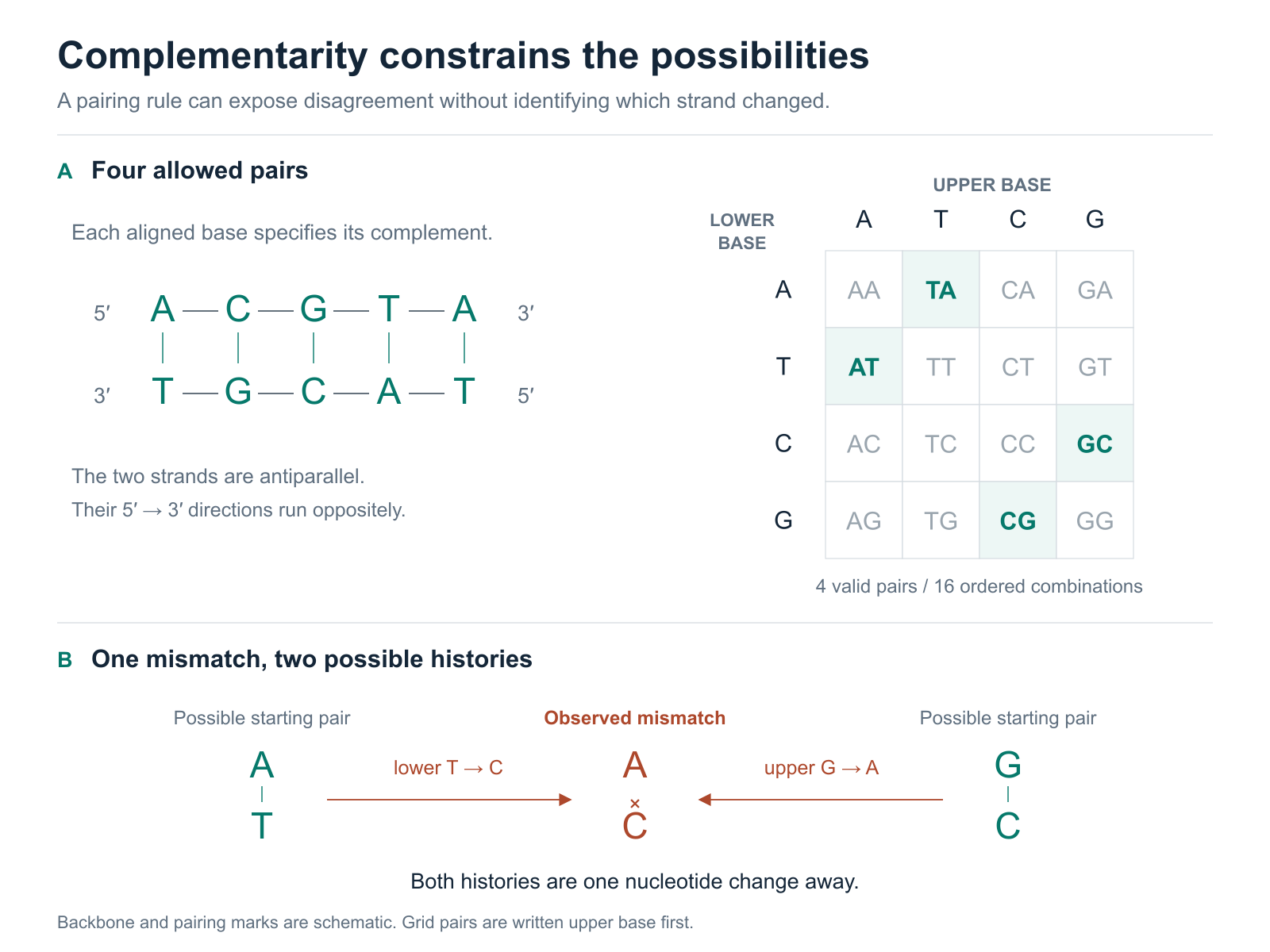
Figure 1. Canonical complementarity restricts sixteen ordered base combinations to four allowed pairs. Each grid entry names the upper base first. The lower panel shows why detecting a mismatch does not determine which strand changed. Diagrams show pairing and connectivity schematically, not atomic structure.
Define C(X) as the complementary sequence in this aligned, opposite-direction convention. If both strands are instead written 5′ to 3′, the second is the reverse complement. Either convention gives a deterministic transformation.
It follows directly that
H(C(X) | X) = 0, and H(X, C(X)) = H(X) ≤ 2n.
The second strand adds physical material without adding independent canonical sequence choices. That is the relevant redundancy: only a restricted subset of all possible pairs of strands is allowed.
The consequence becomes clearer at a single aligned position. Of the sixteen possible ordered pairs of canonical bases, our model accepts only four:
𝒞 = {(A,T), (T,A), (C,G), (G,C)}.
Any two distinct members differ in both coordinates. In coding theory language, this code has minimum Hamming distance two: two represented symbols must differ between one allowed pair and another. This counts differences between symbols, not independent biological mutation events.
We can derive its capabilities without assuming that a cell literally implements a digital decoder:
- If one base is missing and its location is known, the other determines the missing symbol, provided the remaining base is trustworthy.
- If exactly one base is substituted, the resulting pair violates the constraint, so the error is detectable in the model.
- The inconsistent pair alone does not determine which coordinate changed.
For example, (A,C) could result from (A,T) by changing the second base, or from (G,C) by changing the first. Both explanations require one substitution. Complementarity can identify disagreement without settling its history.
The same limitation persists for longer duplexes: extending this coordinatewise constraint does not create a majority vote at each position. The full unconstrained sequence code still has minimum distance two.
3. A broken strand is not necessarily a missing message
Different kinds of molecular damage correspond to different reconstruction problems. In particular, a single-strand break does not necessarily remove a base.
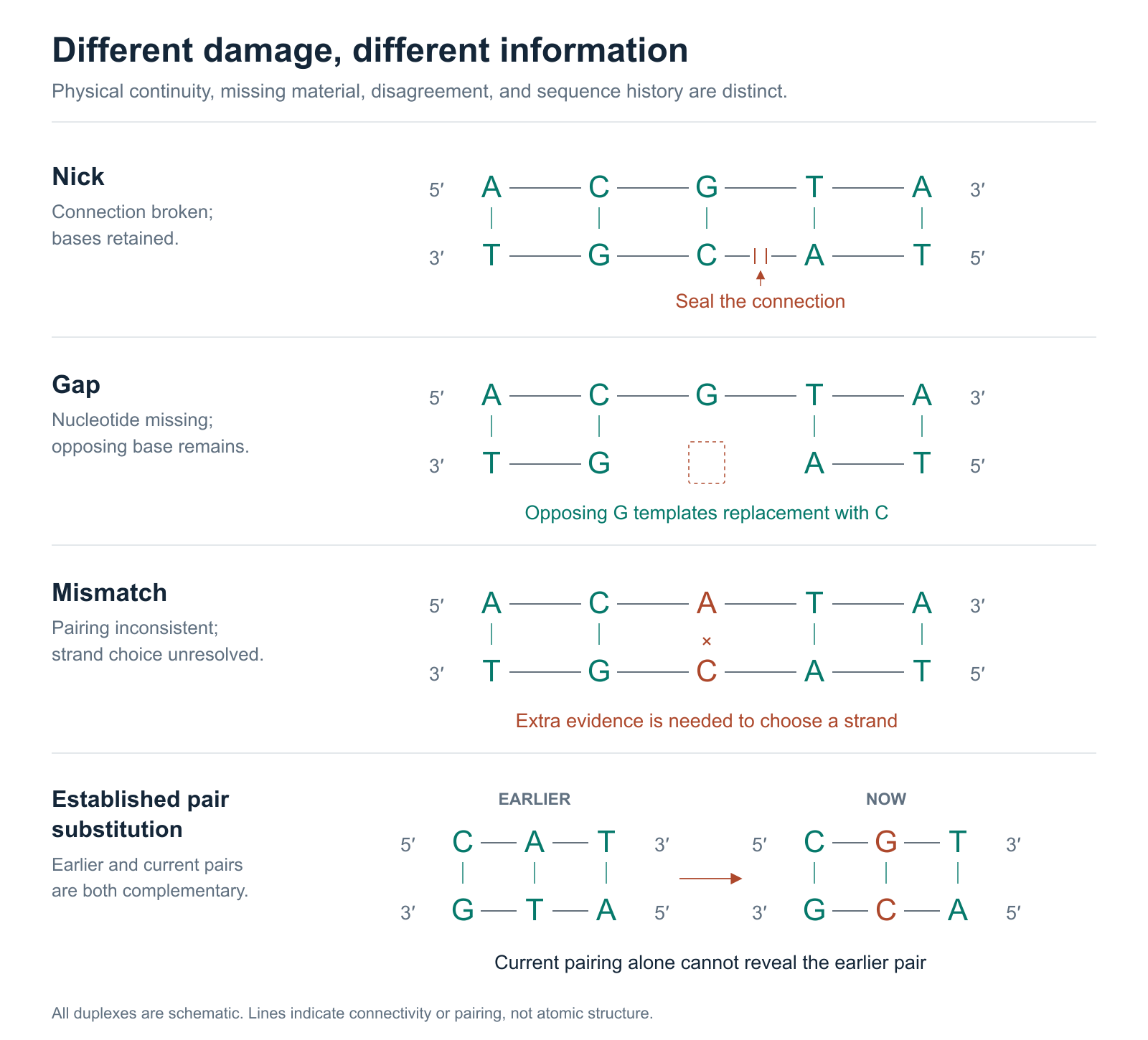
Figure 2. A nick concerns connectivity; a gap requires replacement material; a mismatch creates a choice of reference strand. An established substitution can preserve complementarity while changing the sequence. The first three rows describe local damage states; the last compares two points in a sequence's history.
A nick interrupts one strand's backbone while leaving its sequence present. A clean, appropriately terminated nick can be sealed by DNA ligase; the structural work on human ligase I shows how the enzyme engages nicked duplex DNA. There need be no missing letter to infer. Pascal et al., 2004.
A gap contains missing nucleotide material. Here an intact opposing strand can provide a template for replacement synthesis, followed by sealing. In a reconstituted bacterial base-excision repair system, purified enzymes removed uracil, replaced the affected nucleotide material, and ligated the strand. This supplies a concrete molecular example of template-supported restoration. Dianov and Lindahl, 1994.
Calling a gap an erasure is useful only under explicit conditions. The missing position must be localized, the strands must remain correctly aligned, and the template must retain the relevant information. An arbitrary deletion in a sequence read, where alignment is unknown, is a different decoding problem.
This also sharpens the redundancy argument. An intact partner can preserve a template and support reconstruction. It does not guarantee that transcription or replication continues normally through every break, nor does the information-theoretic model explain all the chemistry required to complete repair.
4. Mismatch repair needs evidence about origin
A mismatch presents the ambiguity illustrated by (A,C). To restore the earlier sequence, a repair process needs some basis for choosing one strand as the reference.
In the Escherichia coli methyl-directed pathway, methylation provides such a cue. Lahue, Au, and Modrich reconstituted mismatch repair with purified components and showed that strand choice depended on methylation at a GATC site. A signal outside the mismatched base pair could direct which strand was corrected. This is a specific bacterial mechanism, not a universal rule for DNA repair. Lahue et al., 1989.
Eukaryotic systems use different machinery. Experiments with human proteins showed how PCNA, a ring-shaped replication protein, and its loader RFC contribute to activating and directing the MutLα endonuclease. Strand discontinuities and PCNA loading orientation help connect an observed mismatch to the strand to be processed. Pluciennik et al., 2010.
Information theory provides a useful interpretation of these experiments. Let X now denote the sequence before the error, and Z represent observations beyond the two base identities: strand marks, a discontinuity, or the state of associated proteins. An abstract decoder would choose a candidate earlier sequence using
x̂ = arg maxₓ P(X = x | observed duplex, Z).
Evaluating this posterior requires both a prior over earlier sequences and a model of how they produce the observations; complementarity alone supplies neither. This is a model of the inference problem, not a claim that repair proteins explicitly evaluate probabilities. It makes the contribution of the extra observations visible: they can favor one reconstruction among several compatible with the mismatch.
The repair system thus contains both a redundant representation and a mechanism for deciding how to use it. The second strand supplies a candidate reference. Molecular context supplies evidence about whether to trust that reference.
5. Which changes can escape the constraint?
Suppose an earlier (A,T) pair becomes a properly paired (G,C). The resulting state satisfies our code perfectly. A check of complementarity alone cannot establish that a substitution occurred, much less recover the original pair.
This is the distinction between detecting an inconsistent representation and identifying a historical change. An established sequence mutation need not leave a mismatch. Experiments on lesion segregation document how replication across persistent lesions can yield mismatches and, in subsequent rounds, fully paired mutations. Here, “established” refers to a change represented as a normal base pair; it does not mean fixation throughout a population. Aitken et al., 2020.
A small calculation makes the limitation quantitative. Assume, purely as a toy noise model, that each base independently changes with probability p, and that a change chooses uniformly among the other three canonical bases. Ignore insertions, deletions, and repair.
If exactly one base changes, the pair becomes inconsistent. If both change, there are nine equally likely outcomes. Three are other allowed complementary pairs. Therefore
P(changed pair that still satisfies complementarity) = p²/3.
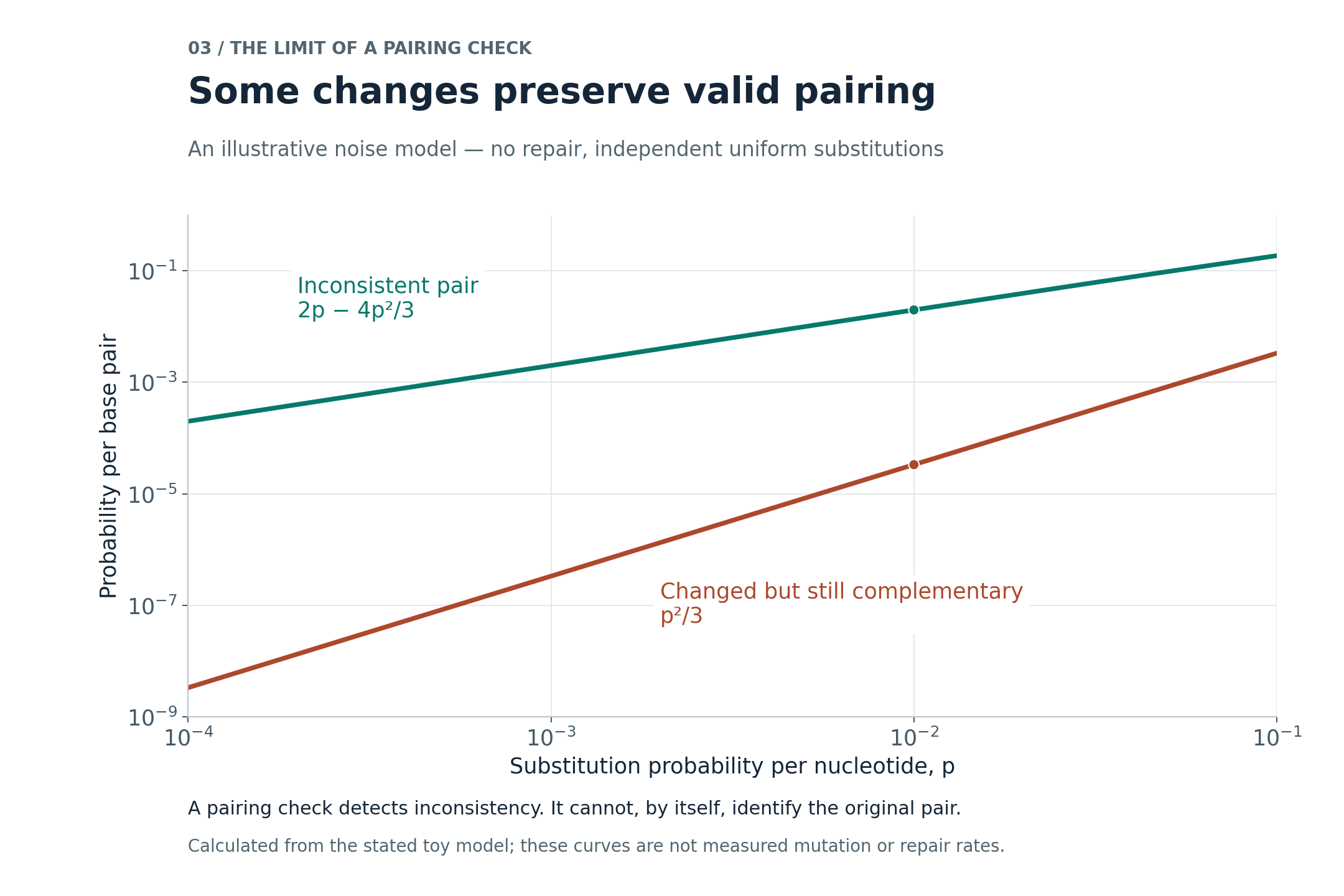
Figure 3. Calculated probabilities for one initially complementary pair. The inconsistent outcomes contain either one changed base or two changes that fail to restore pairing; summing them gives 2p(1 − p) + 2p²/3 = 2p − 4p²/3. Both axes are logarithmic. The curves describe the stated noise model before repair, not observed biological rates.
The quantity p²/3 is an undetected-change probability under the stated model. It is not a measured mutation rate or a prediction of cellular repair performance. Real damage can be correlated, chemically biased, and dependent on sequence context. Nor does detecting the other outcomes guarantee correcting them: the strand-choice ambiguity remains.
The calculation nevertheless isolates a general limitation. A representation can be internally consistent while differing from the state one hoped to preserve. No check that sees only the present pair can recover historical information that is absent from its observations.
6. Reliability belongs to a process
Cells have several opportunities to reduce copying errors. Nucleotide selection acts during synthesis; proofreading can remove a recently misincorporated nucleotide; mismatch repair can address errors that persist. Experiments in budding yeast have quantified distinct contributions of these processes and shown that their effects depend on the particular error and sequence context. St Charles et al., 2015.
It would be misleading to treat them as independent filters with universal success probabilities. An error that escapes one stage is already a selected subset of the errors that entered it. Understanding the complete system requires the conditional behavior of successive stages, their timing, and their access to appropriate templates.
Double-strand breaks expose another boundary. Breaking both backbones does not automatically remove sequence information: compatible ends can sometimes be joined precisely. Primary experiments in human cells demonstrated accurate repair of compatible chromosomal ends through classical nonhomologous end joining. A break therefore cannot be classified as information loss solely from the number of strands interrupted. Lin et al., 2013.
In our reconstruction model, the decisive question is what remains observable. If the relevant symbols survive in accessible fragments, continuity may be restorable without inferring missing bases. If sequence has been lost from both local strands, those strands alone cannot determine it; restoration requires information from elsewhere. The existence and accessibility of a suitable reference then become part of the problem.
One such reference can be a sister chromatid, the related duplex produced during chromosome replication. Experiments in mammalian cells demonstrated repair through gene conversion using this template, showing that biological redundancy can extend beyond the two strands of a single duplex. Johnson and Jasin, 2000.
7. From molecular memory to biological information processing
The duplex model supports a limited but substantive conclusion: complementary storage creates constraints that permit reconstruction under some error conditions. Repair machinery contributes the recognition, contextual evidence, and physical operations needed to exploit those constraints.
This is an analysis of a capability. It is not evidence that error correction is the sole evolutionary explanation for double-stranded DNA, that all genomes use the same architecture, or that organisms maximize a single information-theoretic objective.
The next step is to move from preserving a sequence to using it. A regulatory system must produce distinguishable responses despite molecular variability. Work on transcriptional regulation has formalized this as information transmission between a transcription-factor concentration and an expression output. Mutual information depends on the input distribution, response relation, and noise; channel capacity is its maximum over permitted input distributions. Tkačik et al., 2008.
That supplies a natural continuation: how much can a cell distinguish about its conditions, and what observations would establish that it does so reliably? The same discipline can later be applied to machine learning: define the variables, specify the task, identify the failure modes, and separate a predictive relationship from an explanation of the mechanism.